
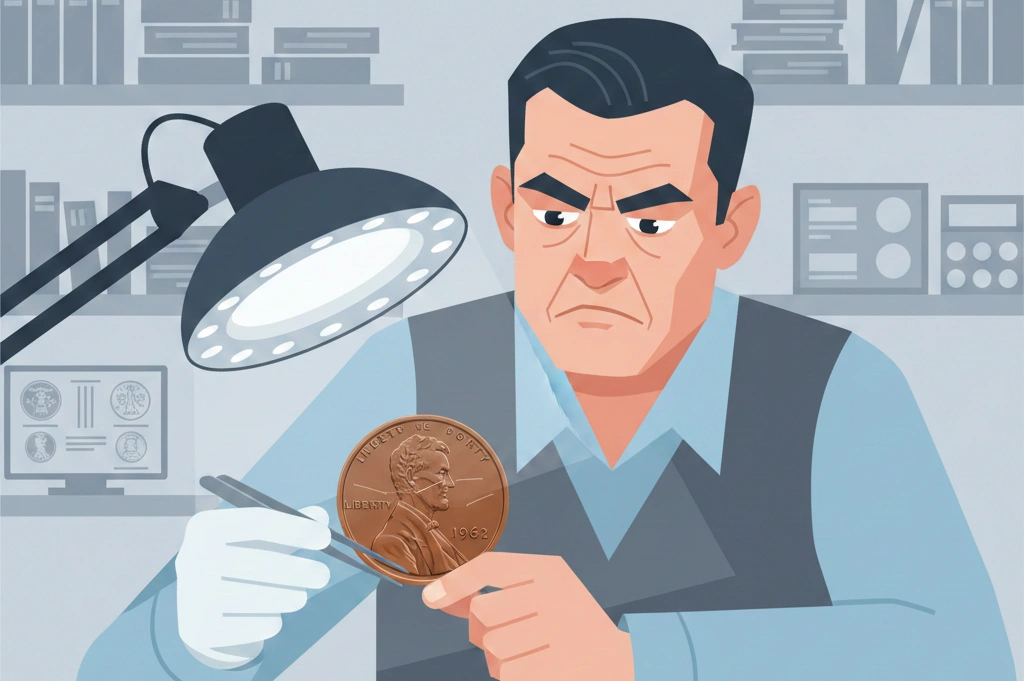
Issued as part of the "Lincoln Memorial" series, the 1962 penny represents a standard one-cent coin.
Primary US mint facilities in Philadelphia and Denver handled the production process.
Total mintage reaching 2,399,171,133 specimens ensured a massive presence of these coins in circulation.
Philadelphia's facility, using no mint mark, produced 606,045,000 units.
Denver's plant, identified by the "D" mark, manufactured 1,793,126,133 units.
An alloy consisting of 95% copper and 5% zinc/tin forms the basis of the coin composition.
Weighing exactly 3.11 grams, the item features a diameter of 19.05 millimeters.
Victor David Brenner’s obverse design contains a portrait of Abraham Lincoln.
Frank Gasparro’s reverse displays the Lincoln Memorial building.
The 1962 penny value depends directly on the preservation of the original surface color.
Mint Facility | Mark | Mintage (pcs) | Material |
Philadelphia | None | 606,045,000 | 95% Copper, 5% Zinc/Tin |
Denver | D | 1,793,126,133 | 95% Copper, 5% Zinc/Tin |
Philadelphia (Proof) | None | 3,218,019 | 95% Copper, 5% Zinc/Tin |
Classification by Color and Its Influence on Price
Grading services (PCGS, NGC) divide coins into three categories: Brown (BN), Red-Brown (RB), and Red (RD).
The RD (Red) category is assigned to specimens retaining more than 95% of the original copper luster.
Transitioning a coin from the RB to the RD category can increase its market value by 300–500% at high grades.
Oxidation caused by exposure to oxygen and moisture moves the coin into the BN (Brown) category, minimizing its numismatic premium.
Comparative Value Based on Color (Grade MS65)
Red (RD): 10 – 15 US dollars.
Red-Brown (RB): 2 – 5 US dollars.
Brown (BN): Face value / 1 US dollar.
Sheldon Scale
For 1962 coins, collector value begins at the MS63 (Mint State 63) grade.
Most coins found in circulation possess a grade below AU58, being valued by metal weight or face value.
1962 Penny Philadelphia, RD
Grade | Price (USD) | Condition Description |
MS63 | 5 | Noticeable small scratches, full luster |
MS64 | 8 | Moderate damage, high preservation |
MS65 | 15 | Minimal contact marks |
MS66 | 45 | High detail, absence of spots |
MS67 | 650 | Exceptional rarity for this year |
1962-D Penny Denver, RD
Due to higher mintage, Denver specimens in MS66 grade occur more frequently, having a lower price compared to Philadelphia counterparts.
Grade | Price (USD) | Status |
MS63 | 2 | Common |
MS64 | 5 | Common |
MS65 | 12 | Collector |
MS66 | 25 | High demand |
MS67 | 350 | Rare |
Auction Sales Records
Peak prices for 1962 pennies are recorded during sales of coins in MS67 condition and higher.
In 2013, a 1962 specimen (Philadelphia) in PCGS MS67+ RD grade was sold for 6,463 US dollars at a Heritage Auctions event.
This result was driven by the absence of other coins worth money in a similar degree of preservation at the time of bidding.
For Denver coins (1962-D), the record stands at approximately 12,000 dollars for an MS67+ RD specimen, established in 2016.
The high price is explained by ideal centering and the complete absence of production defects on the coin fields.
Minting Errors and Varieties
Discovering technical deviations significantly increases the value of the 1962 penny.
The most significant errors include doubled dies, off-center strikes, and the use of incorrect planchets.
Doubled Die Obverse
In 1962, cases of slight doubling on the inscriptions "LIBERTY" and "IN GOD WE TRUST" were recorded.
Unlike the famous 1955 penny, the 1962 doubling is less pronounced.
The value of such a coin in MS60 condition varies from 20 to 50 dollars.
Repunched Mint Mark
The 1962-D issue features varieties with a repunched "D" letter (D over D).
The error occurred during the repeated manual application of the mint mark to the working die.
The value of a specimen with a clearly visible mark displacement stands at 15–30 dollars.

Off-center Errors
The rarest category of errors includes pennies struck on planchets intended for ten-cent coins (dimes).
Such a coin possesses a smaller diameter, a white color (silver alloy), and missing parts of the design along the edges.
In the 2010s, similar specimens were sold at prices ranging from 1,000 to 3,000 dollars depending on the condition.
Market Dynamics and Statistics
The value of ordinary 1962 specimens in MS63–MS65 grades demonstrates low volatility.
Investment interest is concentrated in the MS67 segment, where supply is limited to individual specimens.
Period | Grade MS65 (%) | Grade MS67 (%) | Influencing Factor |
2020 | +1.2% | +8.5% | Demand for alternative assets |
2021 | +0.5% | +12.3% | Online auction activity |
2022 | -0.2% | -4.0% | Market saturation of certified units |
2023 | +2.1% | +5.5% | Rising grading service costs |
Preservation of Proof Coins
Proof coins were issued exclusively for collector sets in Philadelphia.
A mintage of 3.2 million units makes them accessible for acquisition.
Special value is found in coins with the Deep Cameo (DCAM) effect, having a sharp contrast between the frosted image and the mirror-like field.
The price of a 1962 PR69 DCAM can reach 500–800 dollars, while an ordinary PR69 RD is valued at 20–40 dollars.
Methods for Identifying Valuable Specimens
Searching for valuable 1962 coins requires using tools with the best coin value app.
The analysis process includes several stages:
Color assessment: the presence of brown spots automatically reduces the grade.
Mint mark check: searching for signs of a doubled "D" letter.
Letter study in "LIBERTY": identifying signs of DDO.
Edge inspection: searching for signs of striking on a different denomination planchet.
Factors Excluding Numismatic Value
Presence of zinc rot
Cleaning marks
Mechanical hits on Lincoln’s portrait
Absence of natural mint luster
Storage and Conservation
1962 copper coins require protection from aggressive environments.
Using PVC-containing holders is unacceptable due to the emission of acids destroying the metal.
Using acid-free cardboard inserts or plastic capsules made of inert materials is recommended.
Maintaining stable humidity prevents the coin from transitioning from the Red to the Red-Brown category.
Conclusion
The 1962 penny remains a mass-produced coin, with most specimens lacking financial interest.
Exceptional opportunities for collecting and investment open up only upon discovering coins in MS67 condition or possessing rare technological errors.
Stable demand for mint errors ensures the liquidity of such assets provided PCGS or NGC certification is obtained.
Careful selection of coins from unsearched bank rolls maintains the potential for finding rare specimens in the highest preservation category.